JOHN J. Mc MAHON, Sr.
Family Website

Home | News | Calendar | Links | Family Tree | Photo Gallery | Documents | E-mail
J J McM Military | J J McM Architect | J J McM Civic | J J McM Family
John J. McMahon Sr.
Military History

John J. McMahon’s long and impressive military career began on April 1,1895 when, at the age of 20, he enlisted as a Private in the Connecticut National Guard and was assigned to Company B, First Connecticut Infantry.
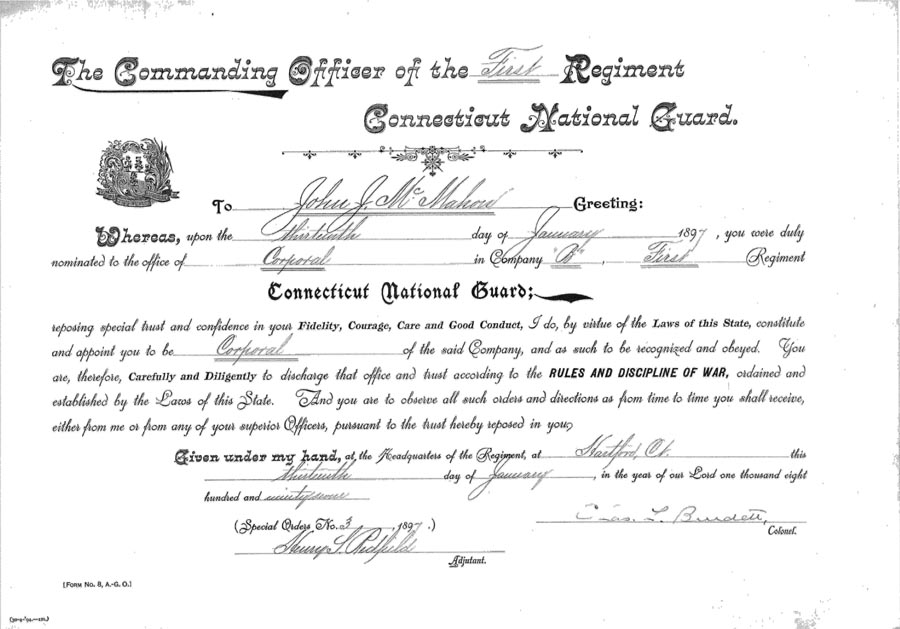
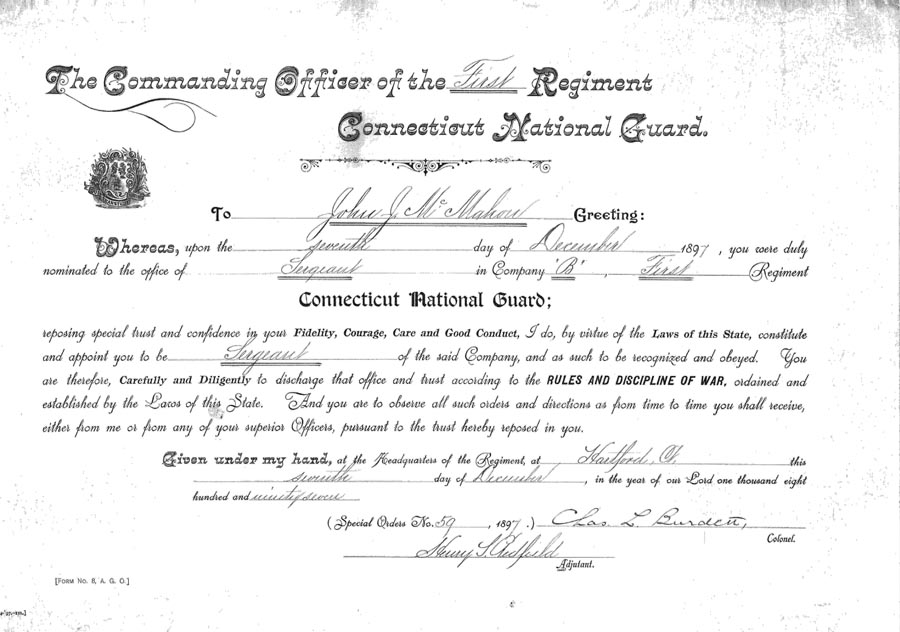
He was promoted to Corporal in December of 1896 and to Sergeant in December of 1897.
On 18 May 1898, in response to the Declaration of War against Spain, John, then age 23, volunteered for and was mustered into United States service with the all volunteer First Regiment, Connecticut Volunteer Infantry and was promoted to First Sergeant of Company B (see photo of 1st Sgt McMahon). As First Sergeant all enlisted men of Company B came under his command and supervision. (see the following brief timeline of the Spanish American War 1898-1901 as given by "sparknotes.com", noting the April through December period when the Connecticut Volunteer Infantry was organized and mobilized.) Spark Notes

Company B, First Connecticut Volunteer Infantry (CVI)
Spanish American War Service Assignments
(approximately 6 months duration)
(*Note–Co. B, 1st First Connecticut Volunteer Infantry
never served outside the United States during the Spanish American War.)
Camp Haven CT 4 May to 8 June 1898
(currently Camp Niantic, CT)
Camp Gull Island, N.Y. 8 June to 15 July 1898
Camp Haven, Conn 15 July to 18 July 1898
Camp Alger, VA 19 July to 7 Sept 1898
Camp Haven, Conn. 8 Sept to 22 Sept 1898
Furlough 22 Sept to 21 Oct 1898
Hartford, Conn. 21 Oct to date of muster out
On October 31, 1898 First Sergeant McMahon mustered out of United States service and returned to service with the Connecticut National Guard.
The “Spanish American War, Centennial Website provides a brief overview of Connecticut’s involvement in the Spanish American War. It also lists all Connecticut volunteers by name, including all members of the First Connecticut Volunteer Infantry. Looking closely at the rosters of Hartford Companies B and H, the reader will see listed John J. McMahon, James McAuliffe (father of Frances McAuliffe McMahon) and a number of Duffy men. It is known that some, perhaps all, of these Duffy’s are brothers to Katherine Duffy McMahon and Sophia B. Duffy.
On June 16, 1899, following his own decision to resign, John received an Honorable Discharge from the Connecticut National Guard and resumed his fledgling career as an architectural "draughtsman" with the firm of Frederick Royal Comstock, Architect and in 1899 moved with that firm from Hartford, CT to New York City. During this period of time (1899-1901) he married Katherine Duffy. Following the birth of their first child, Katherine, the couple returned to Hartford in October 1901 and John entered the firm of John J. Dwyer, Architect.

At this time he also resumed his military career, re-enlisting on November 29, 1901 as a Private in Company B, First Infantry, Connecticut National Guard. A year later, on October 1, 1902 he was promoted to Corporal.
In March of 1903, he was appointed Second Lieutenant Co. B, 1st Infantry, CNG by Governor Abiram Chamberlain.
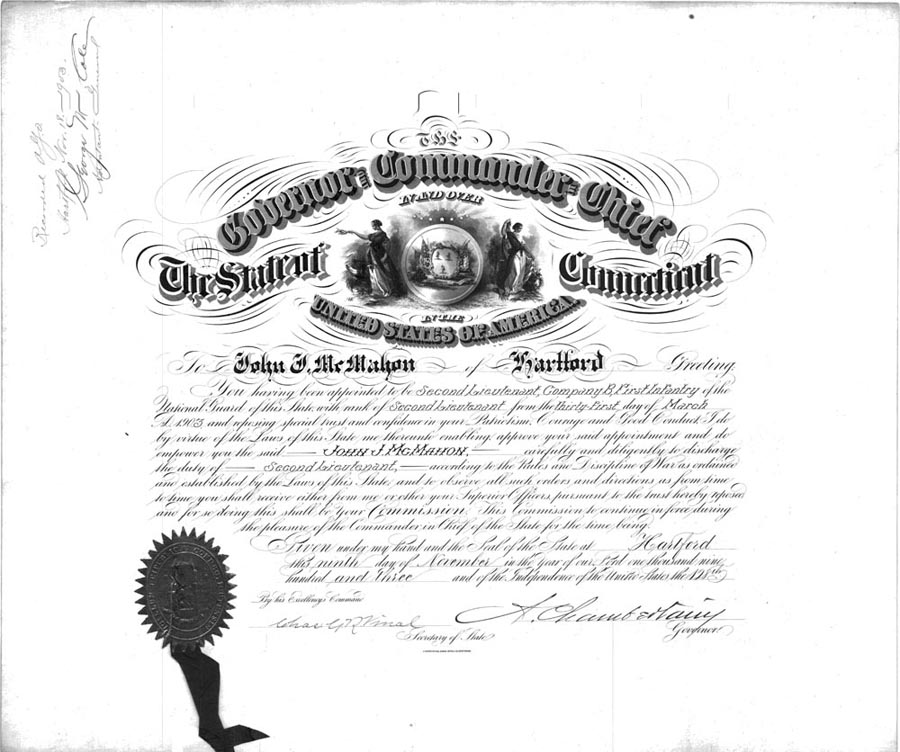
In November of 1903, 2 Lt McMahon was appointed to First Lieutenant, also by Gov. Chamberlain.

In February of 1908, 1 Lt McMahon was appointed to Captain by Governor Rollin Woodruff.
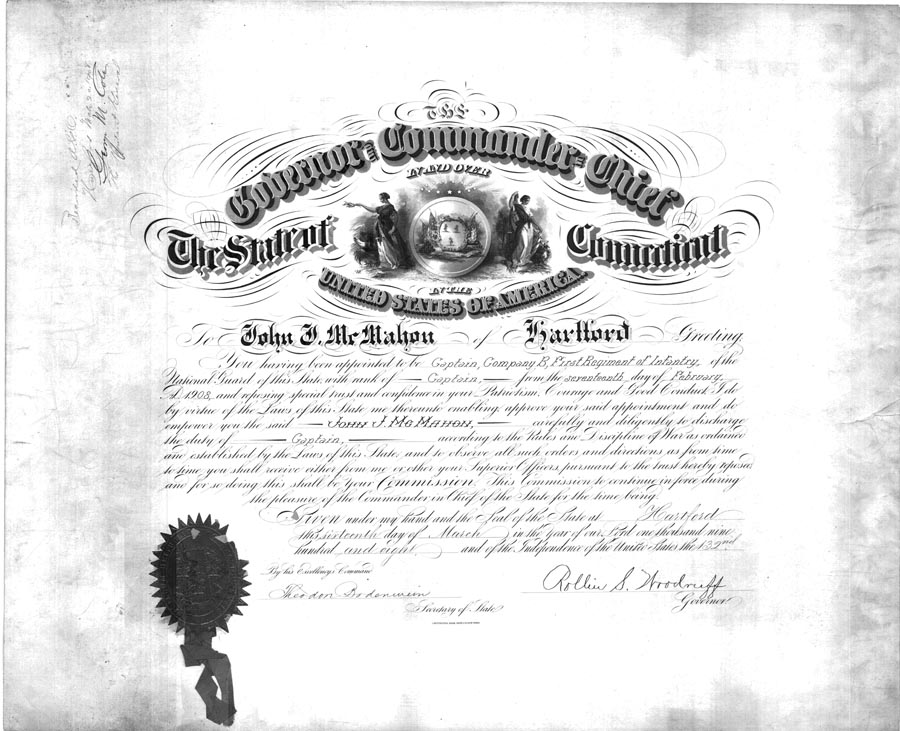
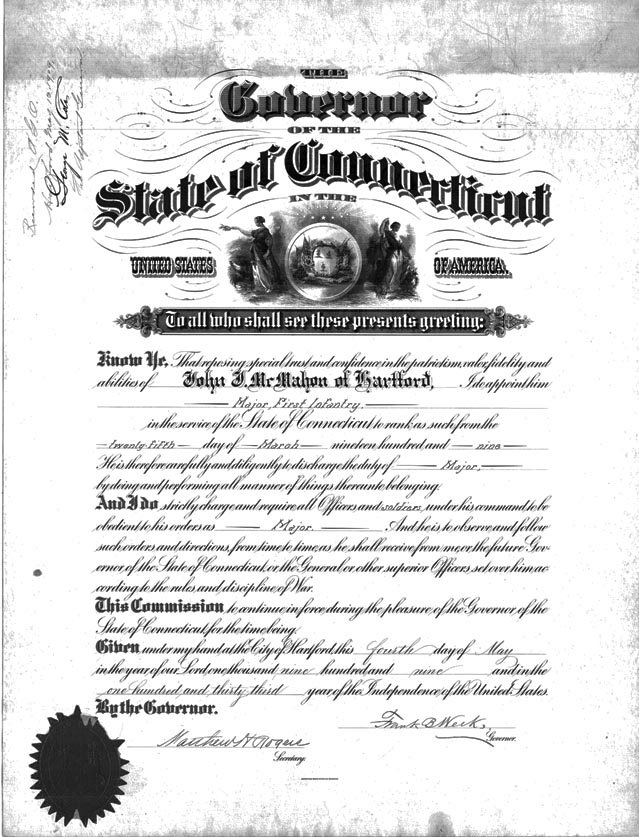
Gov. Woodruff again appointed Captain McMahon to Major in 1909.
1911 records suggest that you didn't want to be the accused in a court martial proceeding with Major McMahon presiding. In those days, discipline was strict and It didn't take much to get booted out of military service. (see court martial hearing)

In June of 1916, Major McMahon was once again called into United States service (U.S. Army) in response to the Mexican Revolution. During this period (20 JUN 1916 through 30 OCT 1916), Major McMahon commanded the First Battalion, First Infantry serving along the Mexican border at Nogales, Arizona
On October 30, 1916 Major McMahon mustered out of United States service and on December 6, 1916 transferred to the Connecticut National Guard Reserve. (see Hartford Times retirement article)

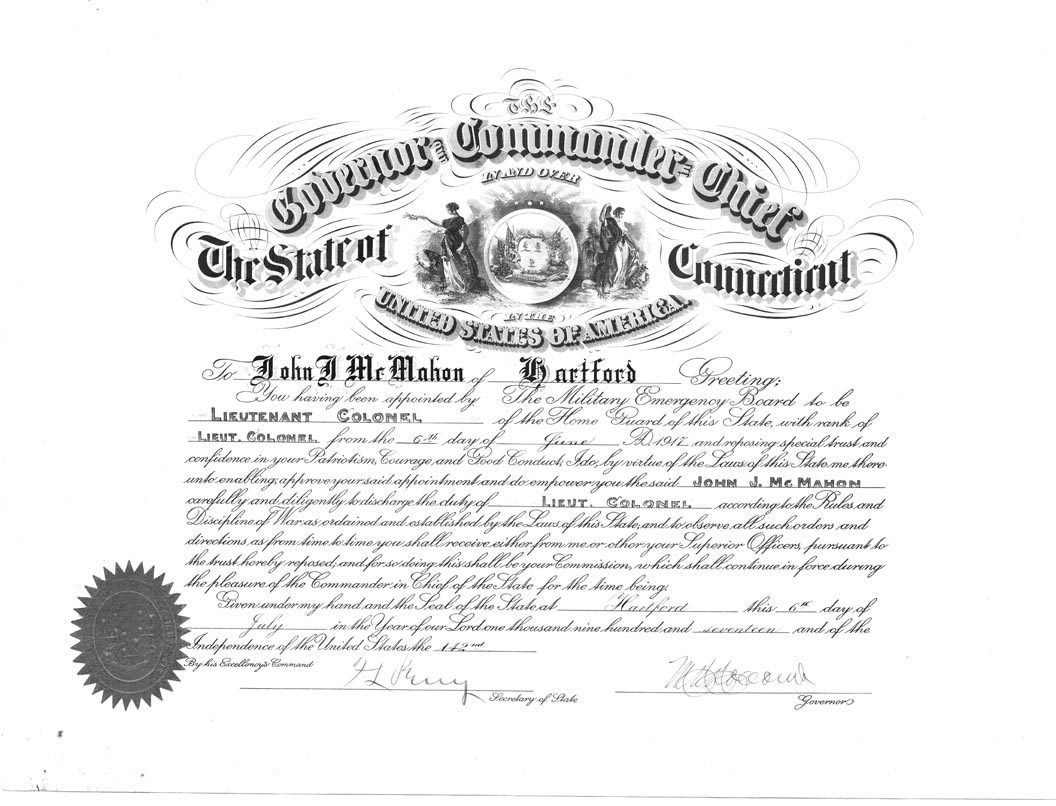
In June of 1917, Major McMahon was appointed Lieutenant Colonel in the Connecticut National Guard by Governor Marcus Holcomb.
On 15 OCT 1918, LTC McMahon voluntarily resigned and received an
Honorable Discharge from the CT National Guard to enable
him to receive a commission in the United States Army (near
the end of WW1- a war with Germany and Austria).
He was then appointed Major, QM [Quartermaster] Corps, United States Army on 26 OCT
1918 and in Nov 1918 he reported for duty at the Quartermaster Depot, Philadelphia, Pa in the following capacity:
Officer in Charge Plant Protection
Maintenance and Repair Division
In January 1919, Major McMahon received an
Honorable Discharge
from the United States Army and transferred to the United States Army Reserve
(see commendation letter) 1924-1931...There is a gap in the records here...John returned
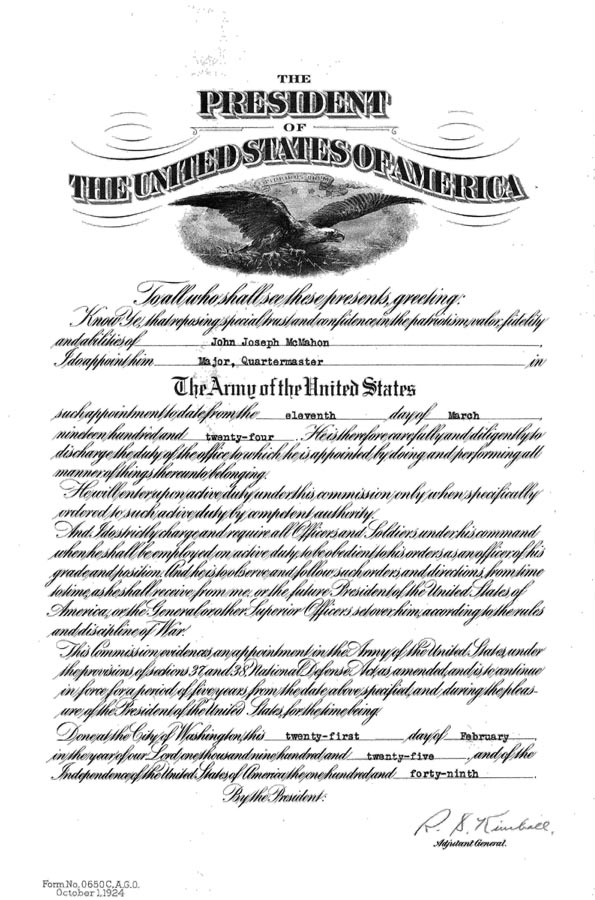
to active duty with the United States Army from 1924 to 1929 as
Major, Quartermaster
Corps but this writer cannot find documentation as to what role or where he served in this capacity. However, a
letter was found dated 1925, acknowledging his re-assignment
to duty as Assistant to the Chief, First Construction District.
Following his leave from the US Army in 1929, John returned to
his position in the the CT National Guard as a Lieutenant Colonel.
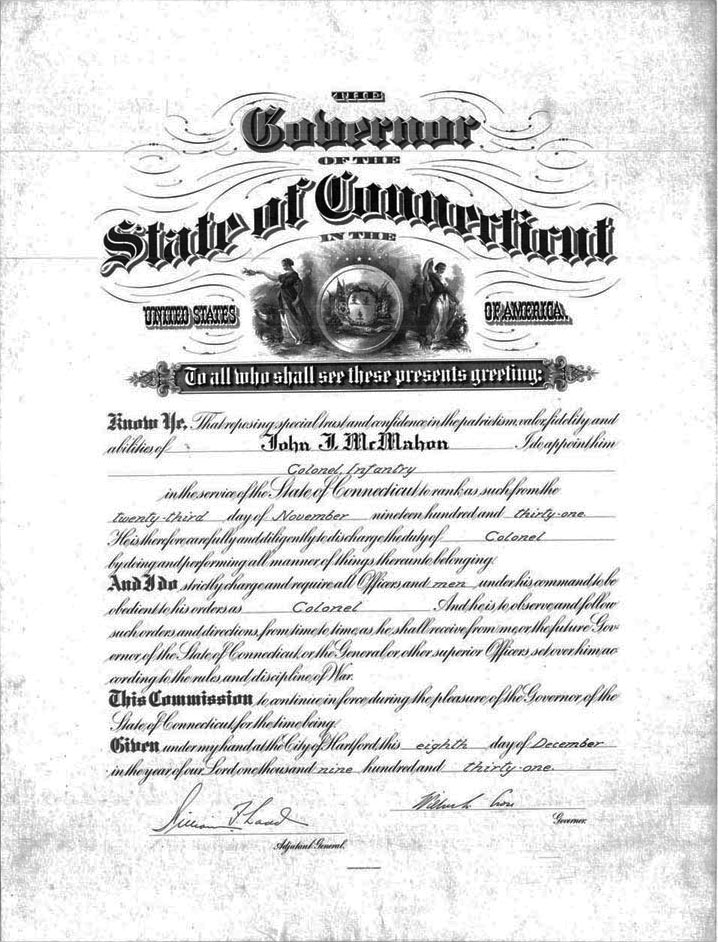
On 23 NOV 1931, LTC John J. McMahon Sr. was appointed
Colonel, Infantry,
Connecticut National Guard by Governor Wilbur Cross. On the same date, Colonel McMahon retired from the military. [Note: According to the writings of his son, Paul R. McMahon Sr.,
John was offered a promotional appointment to Brigadier General CNG, but
declined the appointment due to the constraints of his architectural business. Jim]
Colonel John McMahon was extremely proud of his service in the Spanish American War and was an active and lifelong member of the
United Spanish War Veterans (USWV), Department of Connecticut organization.
Connecticut State Library documents describe
this organization and its mission... “...to unite in fraternal bonds
those who served during the War with Spain or the campaigns growing out
of that war; to honor the dead; to assist former comrades and their
families; to perpetuate the memories of the war and to collect and
preserve the records of service of the individual members of the Order;
to inculcate the principles of universal liberty, equal rights and
justice to all mankind, etc.”
John also played an integral role in a successful movement to establish a memorial honoring the Connecticut
Volunteers who served in the Spanish American War. In 1927, a
memorial tribute to the service of these volunteers was constructed in Bushnell Park, Hartford,
CT. A plaque on the back of this monument documents lists John J.
McMahon as a member of the
planning commission for the monument.
(see letter describing JJM role in memorial acquisition and development) (page 2)


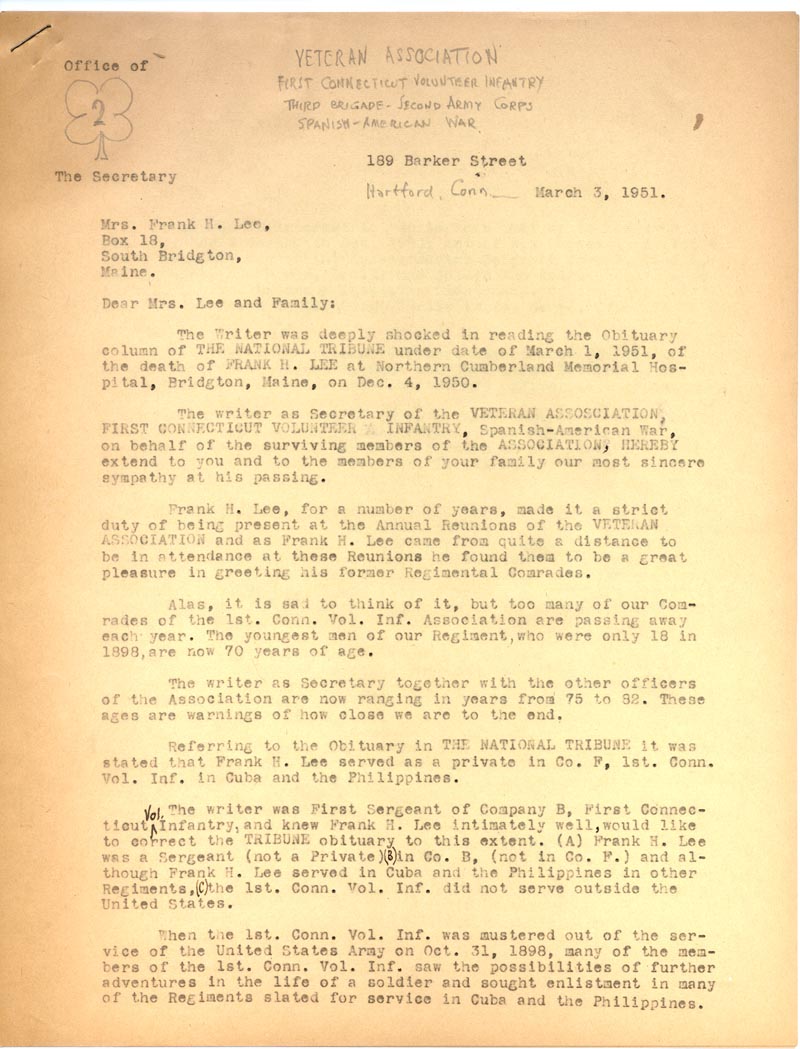
At some point, John McMahon was elected Secretary for Life, in the Veteran's Association, First Connecticut Volunteer Infantry, an honor and position he took very seriously. (see document) His ongoing attention to his duties as Secretary is evidenced by numerous documents related to the organization, covering many years, and written under his signature. In his position as Secretary, he followed the mission of the organization mentioned above with humble devotion, exquisite detail and sincere concern for all of his First Regiment Infantry comrades.

As time went on the men of the First Connecticut Volunteer Infantry became aged as did the Colonel. As Secretary, John continued to keep track of his comrades through their sicknesses and deaths, many times arranging for the elderly representatives of the First Connecticut Volunteer Infantry to attend wakes and funerals as “honor guards”. He wrote to fellow members often, many times weekly. He followed the hospitalizations of his comrades and greeted them as best he could, for his own health was beginning to fail in the mid 1950’s, suffering from the debilitating pain and swelling of arthritis in both his legs and feet. As Secretary, John wrote to the families of his deceased comrades providing sincere and heartfelt condolences from him personally and from the remaining men in the organization. (see example) He always had something positive to say about his comrades to their families. The last documents this writer has seen related to the USWV are dated around 1955. The Colonel died in 1958. Those of his elderly comrades physically able to do so, were in attendance at his wake and funeral. They were his personal friends, his military comrades and his “honor guard” representing the USWV.It was one of his best friends and CVI comrade, Judge Herbert Ross, who wrote an eloquent and moving memorial (see original poem) (see copy) about John’s death and his architectural career. (see J J McM Architect.


Home |
News |
Calendar |
Links |
Family Tree |
Photo Gallery |
Documents |
E-mail
J J McM Military |
J J McM Architect |
J J McM Civic |
J J McM Family